
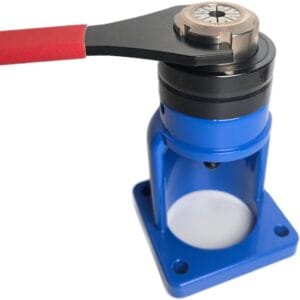
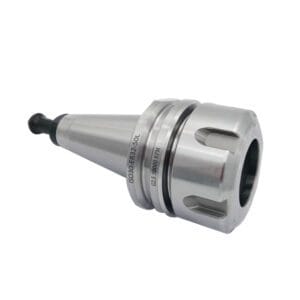
CNC Toolholders are a machine tool accessory that allow precise mechanical connection between your CNC Spindle and CNC Router bit. A Standard CNC spindle, with manual tool change normally uses a specific Collet and matching Collet nut as this interface. For example, ER16 Collet or ER20 Collet. An Automatic Tool Change Spindle or ATC Spindle will use a Toolholder to inface with the spindle and that will hold the collet that will interface with the CNC Cutting tool. For Example, HSK40 or ISO30 Toolholder.
Collet Chucks – ER Collet System
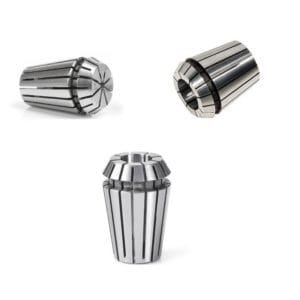
The ER Collet System is standardized and widely used in the manufacture industry for tool holding in spindle applications such as CNC Routing, CNC Milling, turning centers, manual mills, lathes etc. It is a precision tool made from hardened spring steel.
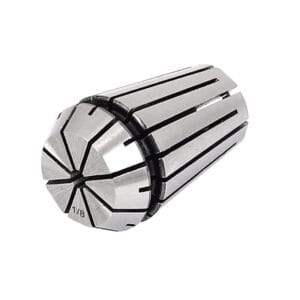
How the ER Collet works
The ER Collets have an external taper made from hardened spring steel, which mates with the same taper internal to the spindle. The internal of the collet is bored out to match the shank size of common CNC cutting tools. The body of the collet has a slotted design that allows for uniform compression when a threaded clamping nut is tightened onto the spindle, forcing the tapered collet inward, compressing the body of the collet uniformly around the shank of the cutting tool. The clamping range to suit tool shanks normally step up in 1mm increments.
Common ER Collet Sizes
The ER collet system uses a standardized sizing convention. The number following the “ER” designates the approximate external diameter of the collet body in mm. The standard sizes are ER11, ER16, ER20, ER25, ER32, ER40.
- ER11: are the smallest on the market and commonly used in very small, desktop or DIY CNC machines. The range is 1-7mm
- ER16: Small capacity ranging from 1-11mm
- ER20: Very common in most CNC Routers and can fit common 1/2″ Tooling. The range is 1-13mm
- ER25: still available in smaller spindles where larger shanks are used. Range is 1-16mm
- ER32: Most common in industrial CNC machines used for sign making and woodworking. Range is 1-20mm or 3/4″
ER Collet Accuracy
High Precision collets offer a Run-Out Tolerance of around 0.005 to 0.008mm. This high accuracy Run-Out ensures concentricity which in turn will reduce vibration and result in longer tool life and better surface finidh.
Spindle Toolholders
The Spindle toolholder are used where automatic tool change is required allowing for quick, easy, and accurate mating of the spindle and the selected tool.
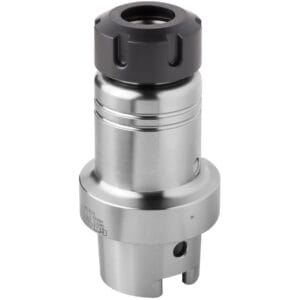
How the Spindle Toolholder works
The spindle toolholder has an external taper that will match the internal of the spindle. This taper aids in automatic alignment of the spindle with the toolholder and requires no human intervention once the cutting tool and collet is mounted in the toolholder. The Toolholder will have a retention mechanism such as a pull stood or clamping interface to ensure solid connection with the spindle and toolholder. Then the internal of the toolholder will have a cutting tool interface such as the ER collet system. Toolholders are precision machine tool parts that are balanced to a high standard which in turn will ensure low runout, vibration, spindle and tool ware.
Common Spindle toolholder sizes
The Toolholder follow a standardized convention such as ISO/BT or HSK and these are not interchangeable. ISO vs HSK:
- ISO30 / BT30 but have a 30degree taper and are commonly used in CNC routing applications. The clamping mechanism relies on a pull stud that a gripping mechanism grabs and pulls the toolholder cone into the spindle cone. The strength and rigidity of the toolholder relies in the clamping mechanism pull force. ISO toolholders are much simpler in operation and tolerance is not as critical. this makes ISO toolholders a cheaper alternative when looking at auto tool change options for your CNC. they can nearly be considered maintenance free.
- HSK have a much sallower taper 1:10 and are more common in higher speed, precision environments. The shallower taper results in a more rigid toolholder so more aggressive machining can take place. The HSK holders use an internal drawbar system that expands two jaws internal to the toolholder, which makes for a very secure grip between the toolholder and spindle. The faster the HSKs internal drawbar spins the resulting centrifugal force expands the clamping jaws further to maintain a tight contact with the toolholder. The tolerance of a shallower cone paired with a face critical internal clamp mechanism, makes HSK toolholders far more expensive than the ISO toolholder. maintenance is far more critical compared to ISO toolholders
Spindle Toolholder Selection, Performance and Application
You must select the correct toolholder to match your spindle. ISO and HSK are not interchangeable.
- ISO Taper is better suited for low cost, low maintenance general milling and routing applications. Sign making CNC, cabinet making CNC and general woodwork CNC. Generally, more available.
- HSK excels in high speed and precision applications where tight tolerance is required, due to its exceptional dynamic balance, minimal runout, and rigidity. Aerospace, precision manufacturing. Higher cost and only available through specialist suppliers.

Leave A Comment