Basics of CNC Cutting Tools
We only recommend using Solid Carbide or Carbide Tipped bits in our CNC machines due to the high RPM and material removal rates our CNC machines can reach. Please ensure the CNC Router bits you use are rated to the RPM available from the spindle. Not all endmills or handheld router bits are suitable for CNC router. The advantage of carbide over other alternatives is long tool life thanks to its hardness with well-matched rigidity and finish. Some basic terms to start off are outlined below:
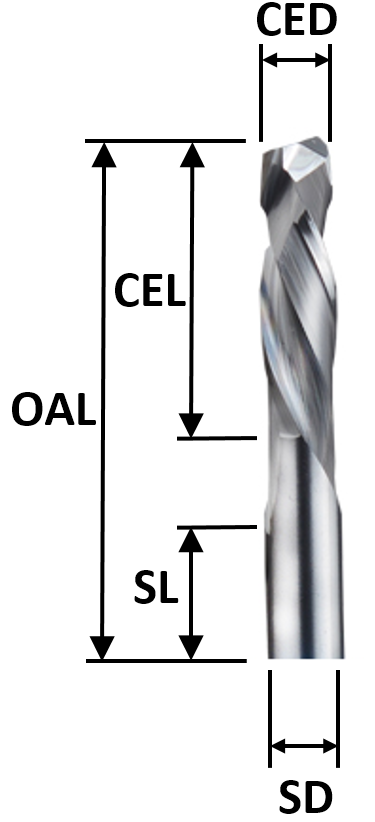
Common dimensions of the tools you need to be aware of are:
CED – Cutting Edge Diameter
CEL – Cutting Edge Length
OAL – Over All Length
SL – Shank Length
SD – Shank Diameter
In choosing a cutting tool for any application, always select one with the shortest cutting edges and the shortest overall length that will reach the required cut depth. Excessive length intensifies deflection and vibration, which degrade cut quality and lead to tool breakage
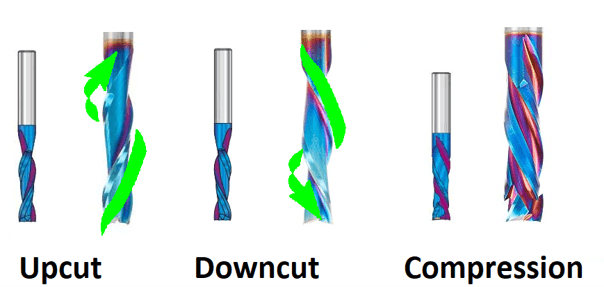
The spiral edges on your cutting tools are known as flutes. The sole purpose of the flutes are to clear the cut chips while minimizing friction on the workpiece. Nearly all tools are design for clockwise rotation, and your spindle is set to spin in a clockwise direction only. Depending on the direction of spiral of the flute, it will determine in which direction your chips will go. If the spiral of the flute is spiraling up when the tool spins clockwise, this is known as Upcut. When the spiral of the flute is spiraling down when the tool spins clockwise, this is known as Downcut. It is worth noting that this spiral rotation will exert a force on your workpiece.
In choosing a cutting tool for any application, always select one with the shortest cutting edges and the shortest overall length that will reach the required cut depth. Excessive length intensifies deflection and vibration, which degrade cut quality and lead to tool breakage
Ready to buy CNC Router bits? Check out our tools here: Cutting Tools – BG Precision

Leave A Comment